“Structure Follows Strategy”
Updated: Aug 31
Volker Beckers CBE on Organisational Design, the Founder Bottleneck and Why Your Org Chart Is Not Where You Should Start

There is a phrase in organisational design so fundamental that everything else builds from it.
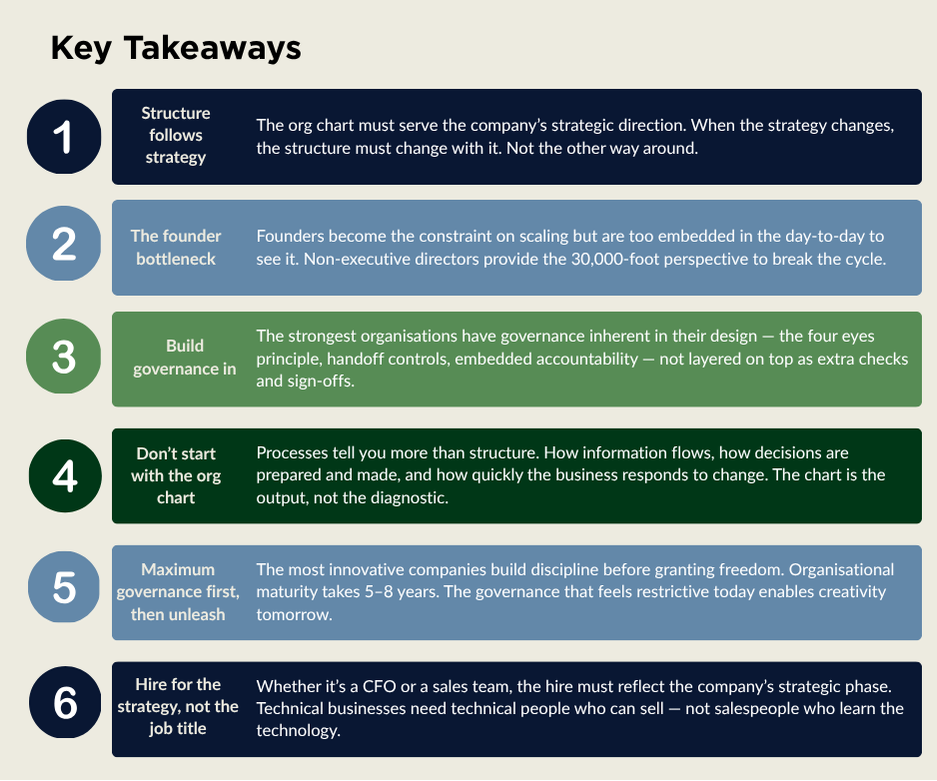
It was coined by the business historian Alfred Chandler, and it is three words long: “structure follows strategy”.
It means that the way a company is organised must serve the strategy it is trying to deliver. Not the other way around. This also implies neither a structure inherited from the last CEO nor an org chart copied from a competitor.
The structure must align with the strategy. And when it doesn’t, the company hits a ceiling; it cannot break through.
“Whatever the strategy of a company is, your organisational design has to adapt to this. If you want to become a more customer-centric organisation, no surprise that you have to focus more on how your customer interface looks. If you move from first-of-its-kind technology to mature technology, you need a different structural setup entirely.”
Volker Beckers knows this from the inside. As Group CFO and then Group CEO of RWE npower — one of the UK’s Big Six energy suppliers — he was integral in the organisational development at RWE.
Now, as a plural non-executive director and chairman across a portfolio of energy, technology and government organisations, he sees the patterns from above: what works, what breaks and where companies get stuck.
He also chairs Green Executives' Renewable Energy Advisory Board. We sat down with him to ask what investors and leadership teams in the green economy need to understand about organisational design — and where the blind spots are.
The Glass Ceiling
FTSE 100 companies invest in getting their organisational design right. They run efficiency and effectiveness measures. They ask the two questions that matter: are we doing the right things, and are we doing things, right?
But as you move down the scale — through mid-market, growth-stage and into the startup ecosystem — organisational design is almost entirely organic. And that creates a problem.
“There come points in the development and scaling of a business where they hit the glass ceiling. They can’t scale because the organisational design inhibits the scaling. The founder becomes the bottleneck. And because the founder is so busy trying to unlock the bottleneck, they can’t elevate themselves to 30,000 feet to reposition what they’ve got. It becomes a vicious circle.”
This is the founder trap. The person who built the company is now the reason it can’t grow. Not because they lack talent or ambition, but because the structure around them was never designed for this level of maturity — it just happened. And by the time they recognise the problem, they are too deep inside it to fix it alone.
Volker’s solution is direct: this is where non-executive directors earn their fee. The founder needs someone who can see the whole picture from altitude and help them redesign the structure without dismantling what works.
Big Eyes Syndrome and the Art of Prioritisation
Growth-stage companies in the green economy face a particular variant of this problem. The market is moving fast. Opportunities are everywhere. The temptation is to chase all of them at once.
“It’s what I call the Big Eyes syndrome. You want more than you can stomach. Founders want to do three different things at the same time, because that’s how they started the journey. But there comes a point where you’re dealing with too many things to do simultaneously. Helping them get the priorities right and focus on what matters most — that’s absolutely key.”
Organisational design is the mechanism through which prioritisation becomes real. A company’s structure should make it obvious what the priorities are, who owns them and what is deliberately not being done. When everything is a priority, nothing is. The org chart and processed within should enforce the discipline that ambition alone cannot.
Governance Built In, Not Bolted On
One of Volker’s most striking insights is the distinction between two types of governance. The first — what he calls ‘law and order’ governance — relies on layers of control, checks and sign-offs. He argues that it is expensive, slow and breeds compliance rather than ownership.
The second is governance built into the organisational design itself.
“You can design an organisation where there is inherent control (checks & balances) between the different departments. If you make a decision and hand it to a colleague as an input, it automatically gets checked. You don’t need to check every single step. You establish a Four Eyes Principle. And you inherently create an organisation which is resilient and robust. Organisational design can help you massively to unleash the potential in an organisation and reduce control by defining a solid and implicit governance structure.”
For investors assessing a portfolio company, this is a critical question: is the governance framework a burden that slows the business down, or is it woven into the structure so seamlessly that it enables speed and accountability simultaneously? The best-designed organisations achieve the latter. Most settle for the former.
Don't start with the Org Chart
When Volker walks into a new boardroom, the org chart is not the first thing he asks to see, and his reasoning is sharp.
“I’m not going into a boardroom asking for an org chart to assess the maturity of the business. It’s more about the people and the way they prepare, process information and decide upon it. It’s the processes within an organisation rather than the organisation itself.”
The distinction matters. An org chart shows you the structure. But the processes tell you whether the structure is working. How does information flow? How are decisions prepared? How quickly can the business respond to something unexpected?
A beautiful org chart with broken processes is worse than a back-of-the-envelope scrawl with strong decision-making. For investors conducting due diligence, the lesson is clear: don’t stop at the boxes and lines. Look at how the work actually moves.
When the Project is Bigger than the Company
At npower, Volker oversaw the construction of two major gas-fired power stations — Staythorpe and Pembroke — representing over £1 billion in capital investment. Projects of that scale demand a different kind of organisational response.
“You go from a stable organisational design to a project design organisation. You need a dedicated project lead who is connected to the main organisation, credible, experienced and can tap into the network — but is totally dedicated to delivering the project mission. You have a hybrid organisation: a project structure embedded within the corporate design.”
For PE and VC investors backing green economy companies through major capital deployments — battery storage projects, wind farm construction, grid-scale infrastructure — this hybrid model is directly relevant. The operating company doesn’t stop running while the project is built. Both must coexist, with clear authority, dedicated resources, and a project lead who owns the outcome.
The Seiko Principle: Maximum Governance, Then Unleash
Volker’s final insight was perhaps the most counterintuitive. Volker points to Seiko’s watchmaking success as heavily tied to its unique organisational structure. The company’s complete vertical integration enables rapid product development. This is tied to its system of competing divisions, creating an environment of relentless innovation and distinct design philosophies.
“The only way of doing this is that the organisation has to go through the most stringent level of control first. And then you gradually unleash the potential — remove the shackles over time. Initially, you start with maximum governance and then you unleash the potential by removing those shackles. That maturity takes between five and eight years to reach.”
This runs counter to the instinct of most founders, who want freedom first and governance later. Volker’s argument is the reverse: build the discipline first, prove the processes work and then progressively grant autonomy. In other words, the structure earns its freedom - it doesn’t start with it.
For companies in the green economy — many of which are still in their first five years — this is a crucial reframe. The governance that feels restrictive today is the foundation that enables creativity and speed tomorrow. But only if it’s designed well. Badly designed governance simply strangles the business. The balance, as Volker puts it, is everything.
Three Types of CFO — and Why It Matters for Org Design
Volker identifies three distinct profiles of CFO, each bringing a different lens to organisational design:

“It’s the simple message: horses for courses. If your business is about integrating acquisitions, the investment banking CFO is invaluable. If you need someone who brings impartial, objective information to the board, hire the finance specialist. If you need someone who can run multiple functions, hire the generalist — and know that they’re the one most likely being considered for a CEO role in the future.”
For investors placing CFOs into portfolio companies through Retained Executive Search Firm engagements, this framework matters. The type of CFO you hire should reflect the company’s strategic phase, not a generic job description. Get it wrong and the org design suffers at the point where financial governance meets operational reality.
Finding the Right Coach
This leads us into Green Executives’ own expertise in this field, and eloquently, Volker reaches for a football analogy.
“The manager has a clear view on what type of football he wants played. Then he needs to decide: does my team actually support the strategy I want to implement? If you have a complex product and you need technical sales, don’t hire just salespeople. Hire technical people who understand it and teach them how to sell. We at Green Executives could help the client find the right coach, help assemble the team, help structurally organise the choreography, and then implement the strategy.”
This is the proposition in plain language. Before you fill the roles, you need to know what game you’re playing. Before you hire, you need to know what the team should look like. And before you restructure, you need to know whether the strategy demands it — or whether you’re just rearranging the same players in a different formation.
Structure follows strategy. Everything else is choreography.